
Library · Articles
Bloodline Warriors of Israel
What happened to our warriors?The Israelite Nation today, measured by the women who fought for the peoples of the captivity.
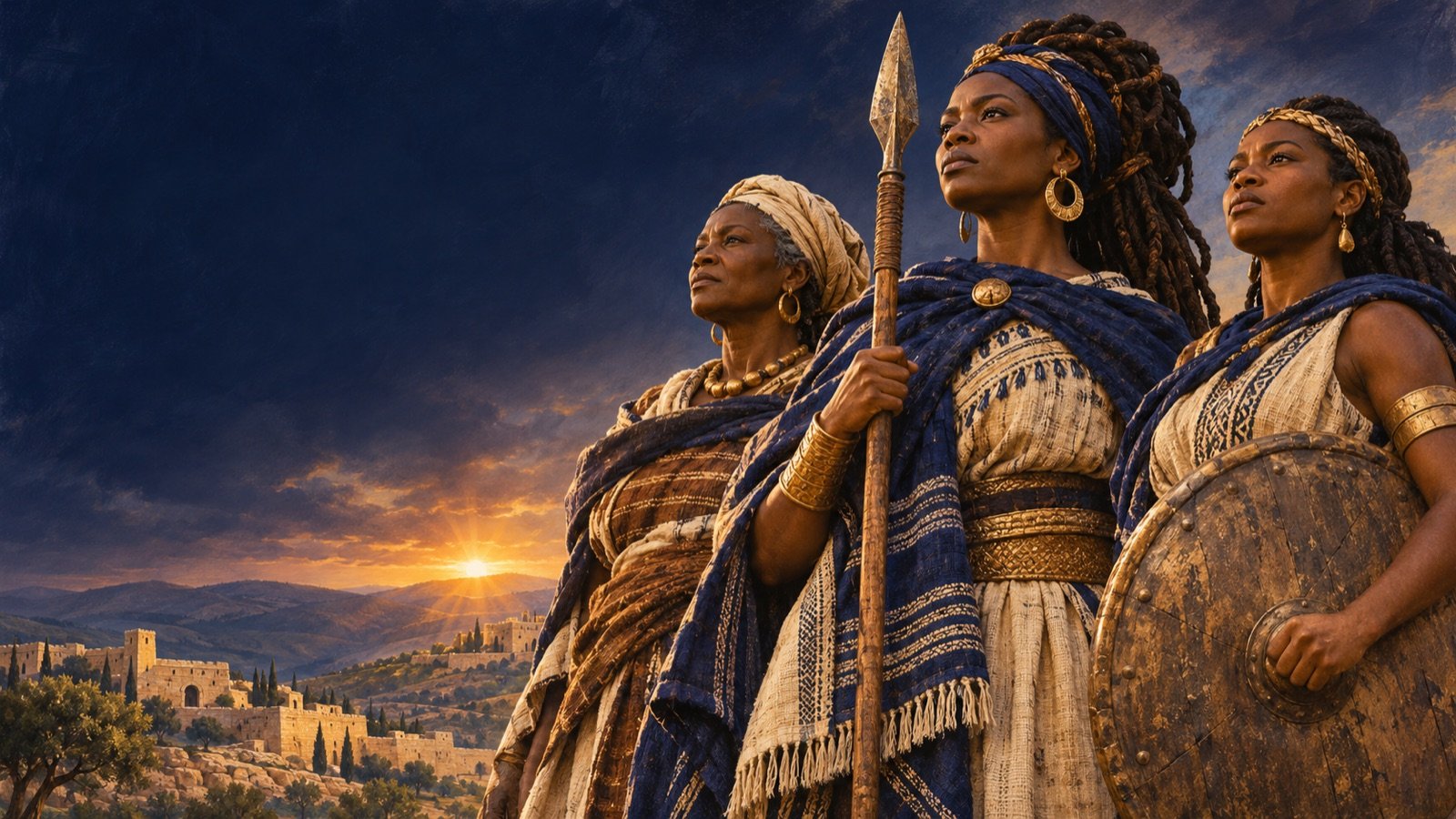
I. The question, in the present
The Israelite Nation Worldwide Ministries is more than forty years old. It has a building, and the building has a congregation. It has a calendar, kept not by the reckoning of Rome but by the new moon, and the feasts are observed in their seasons by a people who were taught, and who teach their children, that they are Israel. It is a place where all of our men are circumcised. On the Sabbath the lessons are given. The songs are sung. An institution that began more than forty years ago, in the teeth of a world that had told these people they were nothing in particular, still stands proudly in the face of adversity.
On the Sabbath the building fills for the lessons and to worship. The months are marked by the new moon and not by the printed calendar of the surrounding country; the feasts come around in their seasons and are kept, in a city that knows nothing of them, by a people who had to recover every one of them. Children sit in the teaching who are hearing names their grandparents were never permitted to hear: Israel, not as a metaphor and not as somebody else's history, but as their own. This is not a community in its first enthusiasm. It is a community in its fifth decade, which is a different and harder thing.
And it is from within that standing, not from outside it, that the question comes. It was put by Elder Shadrock Porter, master teacher and founder of the Israelite Nation Worldwide Ministries, and it deserves to be set down in his words before it is examined in mine: what happened to our warriors?
The man who asks it has the standing to ask it. He has given his life to the teaching of the God of Abraham, the God of Isaac and the God of Jacob, and to the Israelite culture and way of life that belong to Him. It was not the life he first intended: he aspired to sing and to act, and he surrendered that aspiration to this work. The gift did not leave him unused. Most of the songs this Nation sings at its gatherings were written by him, and the pledge its people recite and the coat of arms under which they assemble rose out of his teachings and out of his words. When such a man asks what happened to our warriors, he is not conducting an academic exercise. He is a founder taking stock of his own life's work, and the question is an examination the Nation is being invited to be a part of.
The question is not nostalgia. It is not a complaint about music, or dress, or the manners of the young. It is a question about a function, and before any history is invoked the term must be defined, or the essay that follows is only sentiment. A warrior, in the record this essay is about to assemble, is not primarily a person with a weapon. A warrior is the one who rises, at personal cost, in defence of the people, at the moment when rising is dangerous and hesitation is safe. The weapon changes with the century. The rising does not.
These brave individuals who fought in the old countries, even as far back as the heroes in the Scriptures are from our own Israelite bloodline. They fought then as heroes and continue to fight even after captivity. This Israelite bloodline will soon be forgotten if we do not remember them now. Like before, most were betrayed by their own. This is why we need the spirit of togetherness and understanding today.
What follows does not tell the women's stories. Their stories are long, and some of them will fill a book. What follows sets them as reference points, the way a navigator sets stars: not to visit them, but to find out where one is. Measured against these women, the present can be described honestly, its keeping and its lack in the same breath. That is the whole method of this essay, and it is the elder's question that demands it.
And the bloodline of the title must be defined as carefully as the warrior, because the whole essay hangs upon it. These women are not a miscellany of brave females gathered from the four winds. They belong to one story: the peoples of the captivity, the children of Jacob carried by ships into the new Egypt (the Americas and the Caribbean islands) and scattered among the nations in fulfilment of Deuteronomy 28, and, at the trade's source, the peoples of the African ground from whom the captives were taken. The bloodline that runs through the warriors of this essay is that line.
It is a claim of Scripture before it is a claim of any laboratory: the scattering was prophesied, the ships were prophesied, and the peoples who endured them are identifiable in the record of what was done to them and of what they did. What runs in the line, surfacing in generation after generation, is the arising itself: the refusal to let the people perish undefended. It surfaces in Deborah's Israel and continues in Angola and Waalo and Asante; in Palmares and Saint-Domingue and St Croix; in a quilombo's forge and on a fort's ramparts and at the head of a hundred women gunners, as though the line remembered what it was for.
That recurrence, traced through peoples and centuries, is the bloodline of Israelites this essay follows, and it is why the essay's question can be asked of the present at all: a line that produced warriors in every generation of the captivity may fairly be asked where its warriors are in this one.
II. The scriptural measure
Scripture sets the pattern early, and sets it without embarrassment. Israel is oppressed by Jabin, king of Canaan, and the captain of his host is Sisera, with nine hundred chariots of iron. The judge of Israel is Deborah, a prophetess, and she summons Barak and gives him the word of the LORD: take ten thousand men to Mount Tabor, and the battle is promised. Barak answers with the hesitation that will echo through this entire essay: "If thou wilt go with me, then I will go: but if thou wilt not go with me, then I will not go" (Judges 4:8). Deborah goes. She also tells him, plainly, what his hesitation has cost: the journey shall not be for his honour, for the LORD shall sell Sisera into the hand of a woman.
Both halves of her sentence came true. She went up to the battlefield with the army, and the battle was won; and Sisera, fleeing on foot, was killed not by Barak and not by any soldier, but by Jael, another woman, the wife of Heber, with a tent peg and a hammer, in the privacy of a tent. In the next generation the pattern repeats in miniature: Abimelech, storming the tower of Thebez, is stopped by a woman on the roof, who casts a piece of a millstone down and breaks his skull, and the assault dies with him (Judges 9:53).
Deborah herself left the measure of the desolation that preceded her, and she left it in a song, which matters to this essay more than may first appear. "The inhabitants of the villages ceased, they ceased in Israel, until that I Deborah arose, that I arose a mother in Israel" (Judges 5:7).
A people withdrawn, emptied out of its own villages: that is her description of the time before the arising. And she sang the record of it herself, naming the tribes that came and the tribes that stayed by their rivers and their ships, so that the first keeper of the names in this whole history is the warrior. The arising and the recording are, from the beginning, one work.
Let the shape of this be seen clearly, because everything in this essay hangs on it. In the scriptural record, the arising of the woman in the hour of oppression is not an irregularity to be explained away. It is a recurring instrument of deliverance, and it characteristically appears at exactly the point where the appointed men are calculating the risk. Deborah did not seize a role that was not hers. She was judge and prophetess already. She simply refused to let the nation's danger wait upon other people's courage. That refusal, repeated across three thousand years and an ocean, is the subject of this essay.
III. The African ground
Before there were captives, there were kingdoms, and the trade in human beings had to be fought at its source before it was fought anywhere else. The women who fought on the African ground were not resisting a system in the abstract. They were defending their own countries against the power that had come to buy and to take.
Queen Nzinga of Ndongo and Matamba, in what is now Angola, sustained that defence for forty years. She inherited a kingdom under Portuguese pressure and rebuilt its alliances under fire; she made war and she made treaties, in whichever order the survival of her people required; she adopted the guerrilla methods of the Imbangala, treated with the Dutch when the Dutch were useful, and broke with them when they were not. The Portuguese, who were not accustomed to being outlasted, made peace with her in the end on terms she could accept. She died in 1663 with her kingdoms unconquered. Let the length of that sentence be felt: forty years of refusing to be finished.
In Senegal, Ndaté Yalla Mbodj, crowned Lingeer of Waalo in 1846, left the essay a gift few of these women could leave: her own words. Her letter of defiance to the French governor, dated 18 June 1847, survives. The country belonged to her, she told him, and each chief would govern his own country as he saw fit. She then directed her kingdom's resistance, against the Trarza from the north and against Faidherbe's France from the coast, while her husband commanded the army in the field. The letter matters because it removes all mediation. This is not a chronicler praising her. This is the woman herself, doing the arithmetic of sovereignty and declining to surrender it.
In Dahomey, the Agojie, the women soldiers of the kingdom, were an institution centuries in the making, and in 1851 they were led in the field by Seh-Dong-Hong-Beh, who commanded some six thousand of them in the great assault on the Egba fortress of Abeokuta, sketched by the British naval officer Frederick Forbes, who had seen the Agojie with his own eyes and understood that he was looking at generalship. The honesty of this essay requires its line to be drawn here and drawn plainly: that assault served Dahomey's own taking of captives for the trade, and this essay does not celebrate its purpose. What it records is the commander, because the commander is the reference point: a woman to whom a kingdom entrusted its hardest fighting, as a matter of course.
And in Asante, in 1900, the pattern of the second movement returns in full, as if three thousand years had been a single lesson imperfectly learned. The British governor demanded the Golden Stool itself, the soul of the Asante nation, to sit upon. The king was in exile. The chiefs deliberated, and hesitated. It was Yaa Asantewaa, queen mother of Ejisu, who stood before them and shamed them in the words tradition has preserved: if they, the men of Asante, would not go forward, then the women would. She took command. She laid siege to the British fort at Kumasi and held it for months. She was captured in the end and exiled to the Seychelles, where she died, far from the stool she had defended and had not surrendered. Barak's hesitation and Deborah's answer, in West Africa, in the twentieth century, in a woman of sixty years. The reference points are not subtle. They were never meant to be.
IV. Across the waters
Then came the ships, and the war changed its ground. The women of this movement, the same bloodline of Israelites, had no kingdoms to defend. They had been carried, in chains, into other people's kingdoms, and what they defended was something the world had told them did not exist: their own people's right to be free at all. If the African ground shows what the warrior was with a country behind her, the waters show what she was with nothing behind her but the people themselves.
Tradition gives the bridge a name: Aqualtune, a Kongolese commander taken at the Battle of Mbwila in 1665 and sold across the Atlantic to Brazil, who escaped and led her own quilombo within the great Palmares confederation, and who stands at the head of its royal line, mother of Ganga Zumba and grandmother of Zumbi. Beside her, in Colombia, stands Reina Wiwa, who escaped with Benkos Biohó and was crowned queen of San Basilio de Palenque, the first free African town in the Americas, and who helped raise its army and commanded its Maroons through the campaigns that kept it free. In Brazil a century later, Teresa de Benguela took command of the Quilombo do Piolho on her husband's death and ran it for twenty years, its politics, its economy and its defence, its forge and its fortifications, until a Portuguese expedition destroyed it in 1770. These were not raids. They were states, built in the wilderness by people the law called property, and women governed and defended some of the strongest of them.
In Jamaica, the Windward Maroons held the mountains against British expeditions for years, and the records of the very power they fought name their leader: Queen Nanny, in the colonial documents, a woman whose tactical direction Maroon tradition has preserved ever since, and whom Jamaica now honours as a National Hero. In Saint-Domingue, Victoria Montou, called Toya, a former soldier of Dahomey, taught Jean-Jacques Dessalines himself the arts of hand-to-hand combat and the knife, and commanded a troop in her own right; the empire he founded buried her with a state funeral. Her pupil's revolution then produced its own roll of women in arms: Sanité Bélair, an officer who, condemned in 1802, refused the beheading allotted to a common criminal and chose to stand beside her husband before a firing squad, as a soldier; and Marie-Jeanne Lamartinière, remembered on the ramparts of Crête-à-Pierrot in her red head-covering and Mameluke-style dress, keeping the fort's guns supplied in a battle that cost Napoleon some of his finest regiments.
And Solitude. In Guadeloupe in 1802, when France moved to restore the slavery it had once abolished, she fought with the resistance of Louis Delgrès, was captured pregnant, and was held alive for one reason and one reason only: the law would not hang the unborn child with her. She gave birth, and the day after she gave birth, they hanged her. The record of Solitude is not a legend embroidered by descendants. It is a court's record, kept by the power that killed her, and it is enough. A woman who has been stripped of country, of freedom, of name and of future, who fights anyway and pays that price, has defined the outer boundary of the word warrior. Everything else in this essay is commentary on her.
The scale of the thing must not be lost in its roll of names, so let the rest be set in a single rising line. Juana Ramírez, born enslaved in Venezuela, commanded the Batería de las Mujeres, a battery of one hundred women gunners, and held the royalist advance at Alto de los Godos in 1813; her symbolic remains now rest in the National Pantheon, the first Black woman so honoured. In Bahia, Maria Felipa de Oliveira, a fisherwoman, organised the defence of Itaparica Island and burned the Portuguese vessels in its harbour; and Maria Quitéria, who enlisted disguised as a man and, when her sex was discovered, was kept in the ranks for the plain reason that she was too good a soldier to dismiss, rising to lieutenant and the Emperor's own decoration. Zeferina, Angola-born, led the rising of the Quilombo do Urubu in 1826, and her people defeated the first force of soldiers sent against them before reinforcements prevailed. Carlota Lucumí, born among the Yoruba, helped plan and lead the great Cuban rising of 1843 and marched from plantation to plantation with a machete in her hand, freeing the enslaved as she went. In the United States, Harriet Tubman, already the conductor of an underground railroad, served the Union as scout and spy and helped plan and guide the Combahee Ferry raid of 1863, which liberated more than seven hundred souls in a single night. And in St Croix, Mary Thomas, who called herself captain, led the Fireburn of 1878, the largest labour revolt in Danish colonial history, and paid for it with a death sentence commuted to a Copenhagen prison.
Different islands, different empires, different languages: the same woman, arising. This is the reference shelf in full, and it is not a shelf of exceptions. It is a tradition.
V. The men, noted
This essay is the women's, by its commission, and it returns to them directly. But honesty requires the men of the same world to be named, because they stood in it beside the women and the record is not whole without them: Zumbi, who held Palmares for a generation; Cuffy, who held Dutch Berbice, in what is now Guyana, for the better part of a year; Louverture and Dessalines, who carried a slave rising through to a free state; Chirino; Gabriel, betrayed before his day; Denmark Vesey, hanged at Charleston; Quamina and Jack Gladstone of Demerara; Nat Turner; Sam Sharpe, whose Christmas Rebellion hastened emancipation; Damon of Essequibo, hanged in 1834 for raising the flag of freedom over the apprentices; and Paul Bogle, hanged after Morant Bay.
Damon carries this essay's most pointed silence, and it is placed here deliberately. Guyanese memory, carried down and recalled by Elder Shadrock Porter himself from his own schooldays, holds that after Damon's execution, a woman with an Angolan background who was his wife, with a swollen foot, took up a cutlass to fight for him. Her name was not kept. No written record found names her. Consider what that means, set against everything this essay has assembled: the roll of the women is long, but it is not complete, and it is not complete because the keeping failed. A people that does not preserve the names of its warriors will one day stand, as this generation now stands, asking where they went. Part of the answer is that they went unrecorded. The question and the record-keeping are the same work.
VI. The turn: the Nation today, against the measure
So the measure is set. Now let it be applied, gently and without flinching, because the elder who asked the question did not ask it about other people.
The Nation today keeps things. It keeps the Sabbath, and the new moons, and the feasts in their seasons, by a calendar it had to recover against the grain of the whole surrounding world. It keeps a building, and lessons, and a body of teaching, across more than forty years, through the ordinary attrition that dissolves most movements within a decade. Let none of that be minimised: keeping is itself a form of endurance, and endurance across forty years is not nothing. The company of the keepers, who will be named in their place within this movement, is the reason there is a people left to ask the elder's question about.
But keeping is not the whole of the warrior's description, and the reference points of this essay expose the difference with precision. In every generation assembled here, the warrior is identifiable by one mark: she moved toward the danger in defence of the people, at cost to herself, when a safer course was available and was being taken by others. The hesitations are in the record too, and they are always the same hesitations. Barak will go if Deborah goes with him. The chiefs of Asante deliberate while the governor demands the Stool. The danger is never confused. It is simply priced, and found too expensive, by everyone except the one who rises.
The modern siege does not arrive with chariots of iron, and that is precisely its strength. It arrives as comfort, as distraction, as the slow instruction of a people to want safety and entertainment more than they want their own continuity. Against that siege, what is the rising? This essay does not presume to issue orders to a Nation. It observes only that the warrior function, in every age, has been filled by whoever accepted the cost of the moment: in one century the cost was the battlefield, in another the gallows, and in this one it may be nothing more dramatic, and nothing less costly, than the sustained refusal to let the teaching die of neglect: the elders taught while they can still teach, the children taught while they can still be taught, the record kept, the names kept, the standard kept where the young can see it. The women who kept the flame understood this form of the war exactly. Jochebed hid her son under a sentence of death. Shiphrah and Puah, the midwives, defied Pharaoh's direct command and let the boys live, and Scripture says God dealt well with them and made them houses. Miriam stood watch over the ark of bulrushes and then stood, in time, as prophetess in the camp. Louise Langdon Little, Grenadian-born, raised her children under Garvey's banner in a hostile country and taught them who they were. Amy Ashwood Garvey and Amy Jacques Garvey built and edited and organised; Ida B. Wells made the printing press a weapon after the lynching of her friends; Queen Mother Audley Moore carried the demand for repair into every room that would admit her for half a century; Mary Prince dictated her history so that England would have to read what slavery was; Sojourner Truth walked and spoke; Funmilayo Ransome-Kuti organised the women of Abeokuta until a king stepped down; Claudia Jones wrote and organised through deportation; Rosa Parks, a trained and disciplined activist long before her famous arrest, chose her moment; Fannie Lou Hamer, beaten nearly to death in a Mississippi jail for registering to vote, came out singing. The flame-keepers are not the warriors' lesser sisters. They are the warriors in the long form, the form a war of centuries mostly takes. A nation that has only keepers, though, and no longer raises the other kind, the kind that moves toward the danger when the danger comes in person, has answered the elder's question about itself, whether it says so or not.
Where, then, are the warriors of the Israelite Nation today? This essay ends its argument where its honesty requires: with the observation that the Nation has daughters in whom the old pattern is not extinct, and sons it calls its defenders, and a generation of children now being taught the names in this essay's roll. Whether that teaching produces the arising, when its moment comes, is not a question a writer can answer in advance. It is the question the elder was really asking.
VII. The roll of honour, and the question returned
Before the question is given back, let the remaining names be spoken, so that no woman of the register is absent from the essay that her sisters carry. Tradition gives Queen Amina of Zazzau, the warrior queen of the Hausa country, her dates unresolved and her record carried in chronicle and epic, and written here as tradition, openly. Tradition likewise gives Dandara dos Palmares, warrior of Palmares beside Zumbi, unrecorded by any document of her own century and unforgettable to the people who came after her. Queen Hangbé of Dahomey, by tradition the founder of the female royal guard from which the Agojie descended, stands behind the third movement. Kimpa Vita of Kongo, the prophetess who reoccupied the abandoned capital of São Salvador in 1705 and was burned as a heretic in 1706, fought with word and fire rather than arms, and her resistance is recorded here in its own kind. Cécile Fatiman presided at Bois Caïman in August 1791, at the summons from which a revolution rose. Nanny Grigg of Barbados, a literate domestic servant, read the newspapers aloud to the enslaved, spread the news of the emancipation debates, and urged the rising of 1816. Ferminia Lucumí stood beside Carlota in Cuba in 1843. Mariana Crioula rose in Brazil in 1838, beside Manuel Congo. Queen Cubah was crowned by the conspirators of Kingston in 1760 and executed for it. Luísa Mahin of Bahia is held by her son's later testimony to have helped plan the Malê revolt of 1835. And the unnamed commander of the Abary, in Guyana, who took command of some fifty men when her husband the chief was captured, stands in this roll as she stands in the record, without a name, beside the companion of Damon, whose name was not kept either.
Two unnamed women close a roll of the named. That is not an accident of the archive. It is the archive's lesson.
So the question returns to where the elder put it: in the hands of the Nation that reads this. The warriors were here. They were here in Scripture's first centuries and in Angola's, on the African ground and across the waters, in every generation in which the people were pressed, and again and again they were the women. They were not superhuman and they were not symbols. They were daughters of these peoples who decided, at the priced and dangerous moment, to rise. What happened to them is, in part, that some of their names were lost by a people too long forbidden to keep records. What happened to them is, in larger part, a question about us: whether the line runs on, in this generation, in the daughters and sons now sitting in the lessons.
The elder asked what happened to our warriors. The record answers that they came whenever they were needed and were called. The rest of the answer is not in the record. It is in the room.
“So let all thine enemies perish, O LORD: but let them that love him be as the sun when he goeth forth in his might. And the land had rest forty years.”
Judges 5:31, KJV
Look again. Think deeply. Seek understanding.
— C. D. Ford